




Streamline your contract management needs
Start today with GAIA - your new standard for legal management and get legal tasks done efficiently!
Introducing: GAIA Agentic AI Contract Extractions
Read moreA four-way framework for general counsel deciding where legal work belongs – do it, delegate, automate, or outsource. This article shows how to turn that decision from a one-time sort into an operating model that handles most work without you, set escalation triggers that protect your risk appetite, and run it as a quarterly discipline that keeps the function and your own time – pointed at what matters.
Get regular legal insights directly in your inbox
Share via


A four-way framework for general counsel deciding where each piece of legal work belongs and how to turn that decision into an operating model that routes 90% of work without you, sets your risk appetite explicitly, and gives you the numbers to defend both your budget and your team's value to the board.
Every general counsel knows the feeling of looking at the work flowing into the function and thinking: too much of this is landing on lawyers who are too senior for it. The instinct that follows is to ask for headcount but you already know that is the slowest, most expensive lever you have, and that it rarely fixes the real problem. The problem is less too few lawyers and more that the wrong work keeps reaching the wrong desk, and yours too often. With matter volumes rising against flat budgets, nearly half of GCs in Thomson Reuters' 2026 survey name staffing and resources as their biggest barrier to delivering value. This means, "do more with less" has stopped being a slogan and become the condition you are expected to manage.
So let us be clear about what the decision tree below is, and is not. It will not revolutionise your function, and little in it will be news to you. Its job is narrower, and more useful: to take the judgement you already exercise and turn it into clearer, faster, more consistent decisions. Treat it less as an insight than as a rule. One you reach for every time a question of legal operations comes up, and ideally every time you ask yourself: who, or what, should be doing this? But also, make you raise the question more often.
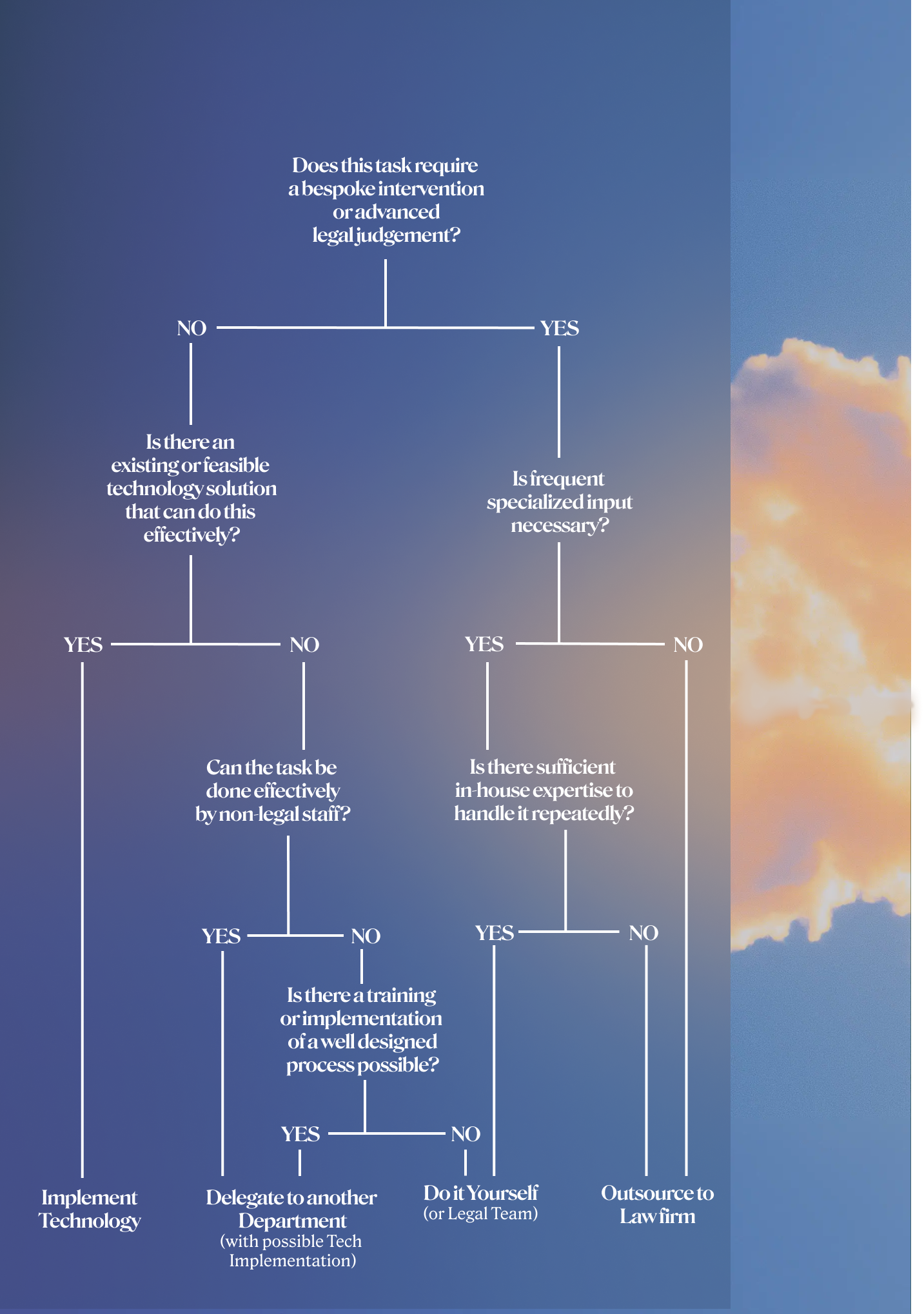
Strip the tree down and it routes every category of work toward one of four homes:
The diagram gets you to one of these through a handful of diagnostic questions. Does the work require bespoke intervention or advanced legal judgement, or is it routine and repeatable? If routine, is there a feasible technology solution, or can non-legal staff handle it with the right training and process? If it needs specialist input, do you have enough in-house expertise to handle it repeatedly, or is this a case for outside counsel?
These are the right questions. But a flowchart implies that each has a clean yes-or-no answer and that work arrives in tidy, single-purpose units. Unfortunately, it does not. That gap is exactly where a framework like this stops being a poster on the wall and starts being a management tool.
Also, the first thing to fix is the unit of analysis. Most of what you call a "task" is not one task. A commercial contract is intake, first-pass review, negotiation, approval, signature, and storage, and those steps do not share a destination. Intake and signature can be fully automated. First-pass review against a standard position can be delegated or run by a tool. The genuinely contested term – the uncapped liability, the unusual indemnity – is the slice that needs a lawyer.
So do not run the tree on "contract review." Run it on each step. The win is almost never relocating a whole workflow into one box. It is decomposing the workflow so the 5% that needs legal judgement reaches it and the other 95% never does.
Here is the shift that separates a tidy diagram from a function that scales. Running the tree once is a sorting exercise. Designing it into the operating model means the decision happens without you for the overwhelming majority of requests.
The target: roughly 90% of incoming work resolves against a documented playbook, and only the matters that genuinely need legal judgement reach a lawyer. That requires four parts and as GC, you own the policy behind each one.
A real intake, not an inbox. If your front door is "email legal," every request forces a lawyer to triage manually, which is itself work you are paying senior rates for. A structured form or portal classifies the request at the door and captures what the function needs up front. Many teams report meaningful time savings from this step alone, before any routing logic is added.
Tiers, with different rules for each. A traffic-light model works well. Green requests – standard, low-risk, high-volume – should not touch a lawyer under normal conditions; they go straight to self-service templates and automation, monitored through periodic audits rather than reviewed one by one. Yellow gets a named owner and an SLA. Red comes to the legal team. Each tier defines who handles it, what timeline applies, and what triggers escalation.
Playbooks that encode your judgement. A playbook is your accepted positions written down – the standard template, the pre-approved fallback clauses, the redlines you will and will not accept. It is what lets a non-lawyer, or a tool, act with your judgement without your presence. For a GC, the playbook is how your standards scale beyond the hours you personally have.
Escalation triggers which are really your risk appetite, in writing. This is the part that is unmistakably a GC decision. Setting the thresholds at which work must come back to legal is setting the organisation's tolerance for legal risk. "Use your judgement" is not a trigger; it is an invitation to route everything back "to be safe." Triggers must be concrete and binary: contract value above a set figure, uncapped liability, special-category data, a counterparty in a flagged jurisdiction, any deviation from the approved template. While none fire, work proceeds without legal. When one fires, the matter routes back automatically. Define them too loosely and you keep the bottleneck; define them well and you have effectively delegated your risk judgement at scale while keeping control of the line.
There is a trap worth naming, because it is where most self-service models quietly fail. If the trigger logic lives only in a checklist a human has to interpret and the team still feels it must double-check whether the checklist was applied correctly. Then the filtering itself becomes the new bottleneck. Congratulations, instead of removing the work, you have renamed it. The fix is to push triggers into intake and automation so they fire on structured data, not on someone's nervous judgement about whether to involve legal. Embed the trigger, audit the category, and resist re-reviewing every green-tier item by hand.
Designed well, technology and delegation stop being separate boxes and start reinforcing each other. The tree's "delegate" destination says with possible tech implementation for a reason: the template library, the self-serve portal, and the automated escalation are what make delegation stick instead of reverting within six months.
Check out our article about how to adopt legal tech successfully!

You can design the intake, write the playbook, and set the triggers, and still watch work creep back onto legal's desk within a quarter. The reason is rarely structural. It is that delegation asks a general counsel to undo the instinct an entire legal career was built on.
Early on in your career, your only real edge is work rate: You answer everything, review everything, are the last set of eyes on everything. That reflex is part of what got you promoted. But seniority inverts the job. You are no longer paid for throughput but for judgement, and the two pull against each other.
"Your job isn't to work hard, your job is to have great ideas." – Joe Hudson
The trap is that busy is easy to measure and effectiveness is not. You can count the contracts reviewed and the calls taken; you cannot as easily see whether your attention moved the business. So the measurable wins, and a full calendar quietly starts to stand in for value – to others, and more dangerously to yourself. Organisations tend to reward visible busyness over quiet effect, which makes the senior lawyer buried in routine review look diligent rather than mis-deployed.
This is why the model reverts, and why holding the line on it is less a process problem than a personal discipline: trusting that the most valuable thing you did this week may have been the work you deliberately chose not to touch.
A decision tree run once decays. Volumes change, the business enters new markets, a regulation lands, you make a hire, or a tool that could not do something six months ago suddenly can. A routing decision that was right in Q1 can be wrong by Q3. Treat the tree as a standing item in how you run the function; ideally tied to your planning and budget cycles, where the conclusions can actually move resources.
Each quarter, sit with it and ask:
A caution on that last point: instincts about workload are reliably wrong. Before you re-sort anything, get baseline data. Have the team track work for a few weeks: What it is, how often it occurs, how long it takes, where the friction sits. The audit is unglamorous and it is the highest-leverage thing you can commission, because it converts "we feel busy" into "this category consumes eleven hours a week and 80% of it is template work." That sentence is what wins budget; "we're overstretched" is not.
Expect change to feel worse before it feels better. New processes and tools follow a predictable arc – implementation, disruption, restoration, acceleration – and the dip is not failure. Part of your job as GC is to hold the line through the disruption phase so the function actually reaches the part where the investment pays off, and to set that expectation with the team and with leadership in advance.
A framework that only ever says "delegate, automate, outsource" will eventually hurt you. A few counterweights you own as GC:
The obvious return is capacity: The same work delivered with fewer senior lawyer-hours, freeing the team for M&A, regulatory strategy, governance, and the board-level work that defines what a modern legal function is for. How you resource also affects whether you keep your people: Axiom's 2026 in-house talent research found that teams leaning on external and alternative providers to manage load saw markedly lower flight risk among their lawyers.
But the deeper payoff is strategic, and it speaks to a problem that should concern every GC. Thomson Reuters' 2026 data surfaced a stark perception gap: 86% of GCs see legal as a significant contributor to the business, while only 17% of other C-suite leaders agree and a substantial share think legal contributes little or nothing. You do not close that gap with assertion. You close it with evidence of how the function spends its scarcest resource and what working smarter freed up. A decision tree you run every quarter, backed by intake data and triage metrics, is that evidence. It lets you walk into a leadership conversation and say: the function redeployed 30% of its routine load, here is the cost it avoided, and here is what it now spends that capacity on. These are the three things the board actually cares about. That is the conversation that turns legal from a cost centre into a contributor in the eyes of the people who fund it.
The decision tree is not a flowchart you consult once and file. For a general counsel, it is the operating logic for the function's scarcest resource – legal judgement – and a recurring check on whether you are spending it where it counts. Do it, delegate it, automate it, or outsource it is the easy part. The discipline is encoding the playbook and the triggers so the answer arrives without you, owning the risk thresholds those triggers represent, and revisiting the map often enough that it stays true.
So the next time the function feels stretched, do not open with who do we hire? Open with: which 30% of what we do this quarter does not actually need a lawyer – and what would the team do with that time instead? That question, asked every quarter and answered with data, is most of the job.
Learn how to audit your workflows, identify where technology delivers the highest return, evaluate vendors with confidence, and measure the impact of every tool you introduce. With that, every technology decision moves your legal department forward.

Written by
Simona Sopova
on
August 18, 2026
Start today with GAIA - your new standard for legal management and get legal tasks done efficiently!
