




Streamline your contract management needs
Start today with GAIA - your new standard for legal management and get legal tasks done efficiently!
Introducing: GAIA Agentic AI Contract Extractions
Read moreThis article argues that visibility was never the real goal in contract management. The first wave of AI made contracts extracted, tagged, and searchable, but left all the reading and judging on your desk, so a tidier dashboard was still a pile of work. Agentic AI changes the category by taking on the first pass of the judgment itself: reviewing a contract against a standard you define and surfacing only what crosses a line, so the output is less to look at, not more, with the human moved from first-pass reader to second-pass judge. It maps where this holds and where it doesn't, which contracts it earns its keep on, the limits worth weighing before you trust it, and how GAIA's Playbooks put the "flag, don't show" model into practice.
Get regular legal insights directly in your inbox
Share via


The first wave of AI in contracts made everything visible: extracted, tagged, searchable. But the reading and the judging stayed on your desk. Agentic AI does the first pass of that judgment itself, so what it hands back is less to look at, not more. Here's where that actually works, where it doesn't, and what to watch before you trust it.
You bought the tool that promised total visibility. Every contract extracted, every field searchable, one dashboard to rule them all. So why do you — paradoxically — have more to look at than before and not less?
Now it is clear that visibility was only step one. And it was not only the easier one but also necessary.
Give the last decade of contract AI its due, because it earned it. Before it, a signed contract was an opaque PDF sitting in a folder. To know what was in it, someone had to open it and read it. The first real breakthrough was turning that document into data: pulling out the renewal date, the payment terms, the liability cap, tagging them, making them searchable across a whole portfolio. Suddenly you could ask a question and get an answer without opening fifty files.
That was genuine progress. It's just worth being honest about what it actually did to your working day.
It made everything visible, which sounds like relief but isn't. A dashboard with forty fields per contract is still forty fields you have to read, weigh, and act on. The tool sorted the pile and put it under better lighting. But, it did not replace a lot of work for you. You still had to look at each flag, decide whether it mattered, and figure out what to do next. Basically the whole judgement process. And this no matter if certain scenarios occurred over and over again.
As a result, the knowledge work never left your desk. The software just gave you a tidier surface to do it on.
You can see this in teams that have "solved" visibility and are still underwater. They can find anything in seconds but they're as overloaded as ever. Now we are starting to realise that finding information was the first step to solving the bottleneck-issue of contract management. But a very important second step is deciding what to do with this information. Seeing a hundred renewal dates is not the same as knowing which three need you this week.
Earlier AI organises information so that you can judge it. Agentic AI does the first pass of the judging and hands you a short list. It reads a contract against a standard you defined, and it surfaces only what crosses a line. Everything that's fine stays quiet.
Sit with how counterintuitive that is. For ten years the pitch was more: more visibility, more data, more surfaced fields. The value now is the opposite. It's subtraction. A good agentic system is measured by how much it can responsibly not show you. But you still have the option to review everything.
And no, this doesn't take the human out of the loop. You just stop being the first-pass reader, the one who has to look at everything to find the few things that matter, and you become the second-pass judge on a list that's already short. Same control over the outcome. A fraction of the volume to get there. It's closer to working with a very fast junior who never gets bored and never forgets a date than to owning a better filing cabinet.
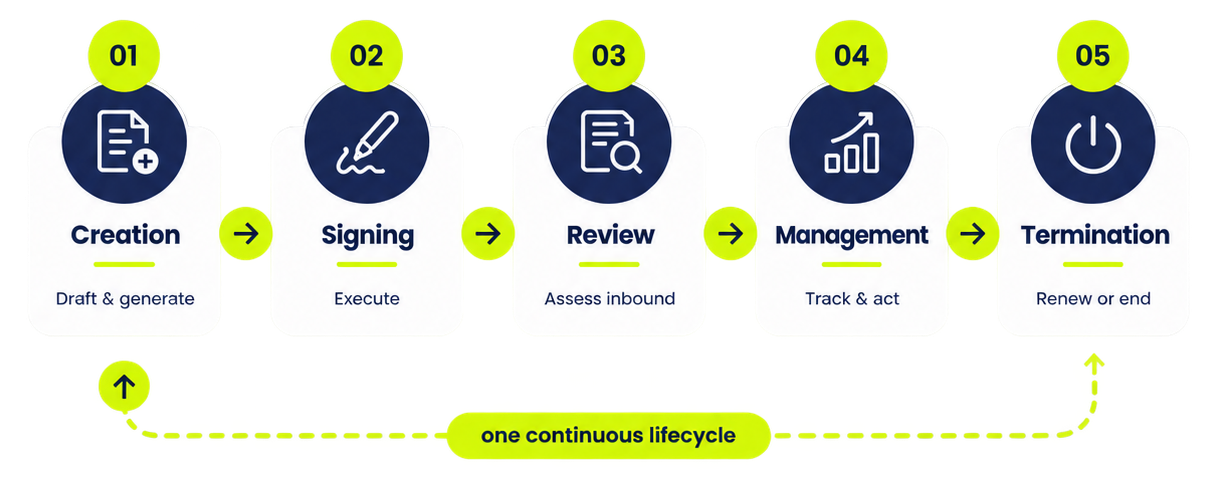
Agentic filtering is mostly powerful in two stages of the contract lifecycle.
It's strongest in review and negotiation. When a third-party contract lands, the job is to read it against your own positions and catch where it drifts. That is exactly a flag-don't-show problem: check the incoming paper against your standard, surface the deviations, leave the rest alone. This is where "review by exception" does the most work, because the alternative is a human reading — or skimming — every clause of every inbound draft. For standard NDAs this is not a good ROI.
It's equally strong in post-signature management. This is where value quietly leaks: the auto-renewal nobody flagged, the SLA the supplier missed, the notice period that passed. These are obligations sitting in the contract that need watching over months and years, and watching is precisely what a person is worst at and an agent is best at. Flag the deadline before it hits. Say nothing the other 364 days.
It plays a supporting role in drafting. Here the job is generative, not filtering. You want help producing language, not a filter deciding what to hide. Agentic AI contributes, but the "surface only the exceptions" framing doesn't really apply.
And it should stay out of the way at approval and signing. These are formal, accountable steps that belong to people. An agent can route an approval to the right person or confirm the version being signed is the right one, but the decision itself is human by design, and it should stay that way.
The takeaway: this is a review-and-manage capability. Claiming it transforms every stage equally is how vendors lose the room. Naming where it doesn't fit is what makes the claims about where it does fit believable.
Exception-based review compounds on high-volume, standardised, lower-stakes agreements where you have a clear sense of "good": As already mentioned, NDAs but also vendor agreements, order forms and standard employment contracts are a good point to start with. You sign a lot of them, they mostly look alike, and you already know what an acceptable one looks like. That's the ideal home for an agent that flags the odd one out.
It's a poor fit for bespoke, high-value, genuinely novel contracts: a major M&A agreement, a first-of-its-kind partnership, anything without precedent. There's no established standard to measure against, the stakes punish a miss, and frankly you want a human reading every line. Pointing a "flag only the exceptions" tool at a one-off masterpiece misunderstands the job.
So the real rule of thumb isn't about length or complexity. It's about clarity. The clearer your definition of good, the more of the reading an agent can take off your hands. Ambiguity is the limiter. If you can't say what "good" looks like, neither can the AI.
None of this works on trust alone, and a system you can't inspect is one you shouldn't rely on. Five things to weigh before you hand over the first pass.
Garbage in. Flagging is only as good as the standard behind it. A vague set of positions produces vague flags. The work you put into defining your standard is the work.
The silent miss. A false positive is annoying: it flagged something that was fine, you glance at it, you move on. A false negative is dangerous: it didn't flag something that mattered, and you never find out. Less noise means you're trusting the filter more, so the quality of that filter matters more, not less. This is the honest cost of "no information overload”.
The confidence question. The differentiator isn't the flag. It's what happens when the model isn't sure. A system that quietly drops the uncertain cases is worse than useless. A system that escalates them to a human is doing its job.
The uncommons. Predefined flags catch known risks. By definition they miss the genuinely unusual clause, the weird one-off buried in an otherwise standard document. That's a real limit, especially in contract types where surprises are common, and it's worth designing around rather than pretending away.
Good CLM Systems have a built-in safety net for this.

Auditability. A flag you can't trace back to the exact clause is a black box. You need to click from the alert straight to the source language and see for yourself. Without that, you can't defend the decision, and a review you can't defend isn't a review.
Agentic AI earns trust by being inspectable, not by claiming to be infallible.
Put those conditions together and you have a fairly exact description of a system worth using. It lets you define the standard rather than inheriting a generic one, because your risk appetite is yours. It reviews against that standard and surfaces only what crosses it, while still being able to surface everything that you really want to see every time. It escalates the cases it's unsure about instead of hiding them. And every flag links back to the exact clause, so you're always one click from checking its work.
This is precisely the model behind GAIA's Playbooks. You give it your gold standard and your own tolerance for risk, it checks incoming contracts against that, and it flags only what crosses a line. The human stays in the loop by design, the uncommon clauses are handled deliberately rather than ignored, and you review by exception instead of line by line. Not a better dashboard. A different job entirely.
Visibility gave us a clearer view of the problem, and that mattered. But a clearer view of a pile of work is still a pile of work. The real shift, the one worth paying attention to, is the first tool that takes part of that pile off your hands and only taps you when something needs you.
The goal was never to see everything. It was to stop having to.

Written by
Simona Sopova
on
August 18, 2026
Start today with GAIA - your new standard for legal management and get legal tasks done efficiently!
