




Streamline your contract management needs
Start today with GAIA - your new standard for legal management and get legal tasks done efficiently!
Introducing: GAIA Agentic AI Contract Extractions
Read moreThis article gets at the oldest problem in contract management, the fact that capturing an agreement was never the hard part but keeping it always was: why legacy CLM was really just storage that left the intelligence to you and a stack of stale spreadsheets, what changes once agentic AI can read, reason, and act on a contract, how GAIA holds the whole lifecycle from creation to termination in one source of truth, the intelligence that lives with each contract and tracks every amendment and obligation, the calendar agent that even calculates the auto-renewal deadlines a contract never spelled out, and the shift from surfacing every field to showing only what matters, with Playbooks reviewing incoming contracts against your own gold standard.
Get regular legal insights directly in your inbox
Share via


Contracts get signed, filed, and forgotten, until a renewal lapses or an obligation slips. Why legacy tools never fixed that, what changes once AI can act on a contract instead of just storing it, and how GAIA covers the whole lifecycle so nothing falls through after signing.
Some of the oldest business records anyone has ever dug up are Sumerian clay tablets. Grain owed, silver lent, who promised what to whom. Five thousand years later, the clay is gone, swapped for cloud storage. The hard part hasn't moved an inch.
Writing the agreement down was never the problem. Keeping it was.
Think about how a contract actually dies in most companies. Someone negotiates good terms. Legal signs off. The file goes into a folder, or a drive, or a system that cost six figures and took nine months to roll out. And then everyone moves on.
Six months later the auto-renewal fires, because nobody was watching the date. Or a team starts buying off-contract because the "approved" way was slower than just emailing a vendor. Or an obligation you owed by year-end slips, and you find out when the other side reminds you. The value was real when you signed. It just never showed up in practice.
This isn't a story about bad lawyers or lazy teams. It's structural. Companies have paid seven-figure settlements over auto-renewal clauses that no human was tracking. That's not an edge case. That's the normal failure mode of contract management, and it's been the normal failure mode for decades.
Here's the uncomfortable truth about legacy CLM: most of it was storage in disguise.
You got a place to put contracts. What you didn't get was anything that understood them. So the actual intelligence, the part that mattered, got dumped back on you. You read each agreement by hand. You pulled the renewal dates, the payment terms, the liability caps into a spreadsheet. And that spreadsheet started rotting the second you saved it, because contracts change and your notes didn't.
A signed contract went into the repository as a static PDF and mostly stayed there. Findable, maybe. Useful, not really. The industry even had a grim little phrase for it:
The place where contracts go to die.
Every wave of software promised to change this. Add e-signature, add workflow, add a nicer search bar. None of it touched the core issue, which is that a contract isn't a file. It's a living relationship with dates and duties that keep moving after everyone stops paying attention.
Now the interesting part. AI, specifically the agentic kind that can read, reason, and take an action on its own, is the first thing to go at the real problem instead of the paperwork around it.
The shift is simple to say and big in practice: a CLM stops being a filing cabinet and starts being something that works on your contracts while you're not looking.
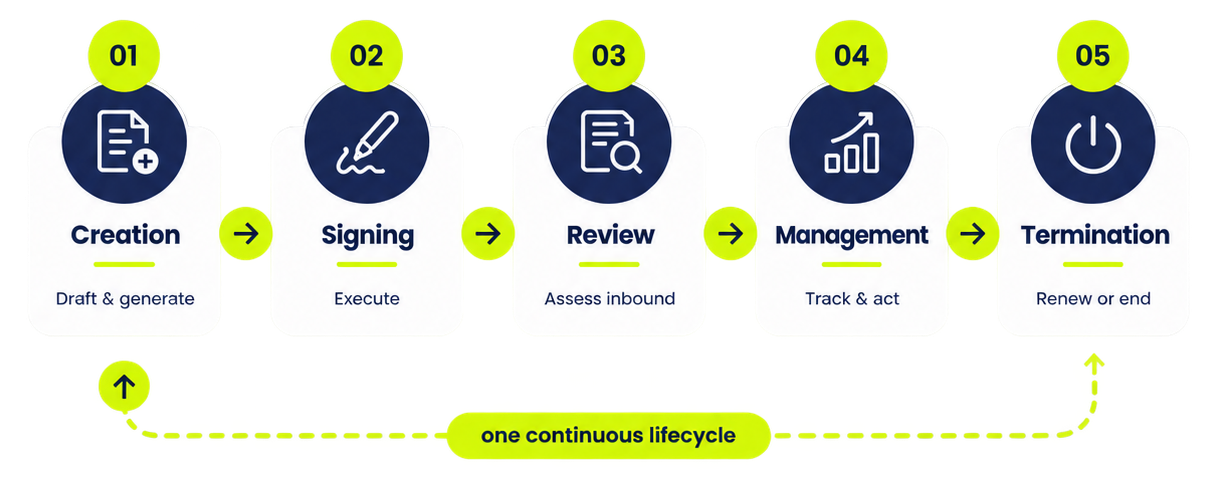
At GAIA, that idea runs through the whole lifecycle, not one clever corner of it. You draft and generate agreements from your own templates. You send them for signature without leaving the platform. You review incoming contracts from the other side against your own standards. Once signed, everything lands in one repository, organised and current, right through to renewal or termination. One place, one source of truth, from first draft to final day. Whether you wrote the contract or someone handed it to you.
That coverage alone puts you ahead of a stack of disconnected tools. But it's what sits on top that earns the word "modern."
The intelligence lives with the contract. Add an amendment or an addendum and the system tracks what actually changed. Which obligations are new. Which ones no longer apply. No re-keying, no stale spreadsheet, and you can always click straight back to the exact clause in the source document to check it yourself. The contract evolves, and your view of it evolves with it.
And it acts. A calendar agent watches your termination windows and obligation dates. It can even work out an auto-renewal deadline that was never written into the contract, then tell you in time to do something about it. Not a reminder you set. A deadline it figured out.
This is the part most people underrate.
For years the pitch for better contract software was visibility. Get everything into one dashboard, make it all searchable, surface every field. Which sounds great until you're staring at a wall of data that's somehow more work than reading the contract would have been.
Visibility is only half of it. Finance, legal, and HR don't want the same forty fields off the same agreement. So they shouldn't have to see them. Each team gets its own view, the handful of things that matter to them, and nothing else.
And sometimes you don't want to see the fields at all. You want an assistant that reads the contract for you and only taps you on the shoulder when something's off. That's what our newest feature, Playbooks, does. You feed it what "good" looks like to you, your gold standard and your own appetite for risk, and it checks incoming contracts against that, flagging only the clauses that cross a line. You review by exception. Not line by line.
That's a different job than storage. It's closer to having a very fast junior lawyer who never gets bored and never forgets a date.

Contracts have outlasted empires. It's about time the software caught up to the part that was always hard.
Written by
Simona Sopova
on
August 27, 2026
Start today with GAIA - your new standard for legal management and get legal tasks done efficiently!
