




Streamline your contract management needs
Start today with GAIA - your new standard for legal management and get legal tasks done efficiently!
Introducing: GAIA Agentic AI Contract Extractions
Read moreLearn why "best practices" keep landing legal teams in the middle of the pack, and what actually separates the teams that get a seat at the table from the ones stuck processing tickets. Discover five principles for measuring legal's value, replacing reflexive "no's" with better questions, delegating smartly, and communicating expectations that build trust with the business.
Get regular legal insights directly in your inbox
Share via


This article walks in-house legal teams through five principles for transforming how they operate: from measuring legal's invisible value and reframing the reflexive "no", to delegating routine work, setting clear expectations, and earning a strategic seat at the executive table.
There's a phrase you hear in almost every company, almost every week:
"It's stuck in legal."
You've probably heard it. You may have said it. And if you work in-house, you've definitely been on the receiving end of its more polite cousin:
"Isn't that why we pay you?"
That phrase, more than any other, captures how legal is seen inside most organisations. Not as a partner. Not as a strategic function. As a vending machine. You put a problem in, a solution comes out: quickly, quietly, without questions or pushback. And when something goes wrong, the vending machine gets blamed.
That reputation is not inevitable. It is a symptom. Of poor visibility, of unmet expectations, of a communication gap between legal and the rest of the business. And every part of it is fixable.
This is what most legal teams keep getting wrong about their own operations and what to do about it.
Before we go further, a quick reframe.
Shane Parrish, the writer behind Clear Thinking – The Art and Science of Making Better Decisions, makes an argument every in-house leader needs to hear: best practices are, by definition, average. If you do what everyone else does, you get what everyone else gets. The teams that genuinely outperform aren't the ones with the longest list of tactics. They're the ones with a smaller, sharper set of principles that they actually live by.
That's why this post is not a checklist of fifty things to do differently. There are already hundreds of those. And besides, doing what everyone else does gets you what everyone else gets.
This article is an attempt to name the underlying first principles that – if you actually held yourself to them – would reshape every part of how your team operates.
So let's get into the uncomfortable parts first.
A senior in-house counsel said something to me recently that stopped me cold:
"Less than 10% of my job is now litigation support – and I was originally hired for exactly that."
Read that twice. The person hired to fight fires is barely fighting fires anymore. Not because the company got lucky. Because the team got better at preventing the fires in the first place.
That single sentence captures the shift in-house legal has undergone in the past decade and the corresponding gap in how most teams talk about themselves.
A legal team where 90% of the work is litigation (or other firefighting activities) is, by definition, a team where almost everything upstream went wrong. Bad contracts. Missing policies. No training. Weak processes. Firefighting is the symptom, not the job. The real job is upstream: better contracts, better policies, better enablement, fewer disputes, fewer crises. And this is something nobody trained you for in law school.
This is also where the hardest tension in the role lives: you have to enable the business to move fast, and not compromise on risk. Most teams pick one. They become the "no" department that protects the company by slowing everything down or the rubber stamp that lets speed win until something breaks.
The teams that get it right do both at once. They design the system so moving fast is the safe option: pre-approved templates, clear playbooks, self-service for low-risk work, and clean escalation paths for the rest.
And here's why this matters commercially. The story you tell leadership changes completely.
"We closed 400 tickets this quarter" is vending-machine language. Nobody at the executive table cares.
"Litigation spend is down 60% over three years because we invested upstream" is a different conversation. So is "sales cycle time dropped two weeks because legal moved standard NDAs to self-service."
That's the language that gets legal a seat at the table instead of a queue at the door.
If you've ever sat down to map what a fully-functioning legal-operations team should be doing, you'll recognise the list:
Building a three-year roadmap. Reconciling outside-counsel spend. Designing the senior-counsel career ladder. NDA triaging. Shifting routine review to an ALSP. Running the CLM rollout across sales, procurement, and HR. Negotiating the new outside-counsel rate card. Building the precedent library. Pulling the monthly dashboard. Evaluating AI contract-review tools. Running GDPR refresher training. Configuring the new e-signature workflow.
Twelve workstreams. All of them important. All of them with someone waiting on them.
Here's the thing nobody says out loud: no team is actually getting all of this done in a quarter. Not yours. Not the team at the company you're benchmarking against. Not anyone's. Some of these will move forward. Some will stall. Some will get started, abandoned, and quietly restarted next quarter as if it's a new initiative.
That's not a failure of the team. That's the math.
The trap is responding to that overwhelm by benchmarking yourself against other legal departments on every single one of these areas, and ending up exactly average across all of them. Remember Parrish: best practices are the average.
What actually moves the needle isn't a longer to-do list. It's a smaller set of principles that shape how you operate everywhere. Five of them, specifically.
Legal is invisible when things go right. A contract that never became a dispute doesn't get celebrated. Legal creates a lot of value but that value is invisible by default. Part of your job is to make it visible.
Leadership, especially finance, sees legal as a cost centre. Every hour a lawyer works is a cost. So when you ask for more resources, more headcount, better tools, the natural response is:
"Why should we spend more on something that already costs money?"
The only answer that works is data. Time saved. Capacity freed up. Turnaround times improved. Disputes avoided. These are the numbers that move decisions forward.
And this is not your fault. Nobody taught you this in law school. Private practice didn't require it either; your value there was measured in billable hours, and someone else worried about the business case.
But in-house, you are a business unit. And in every other business unit, numbers are the language of credibility. Sales has pipeline. Finance has forecasts. Marketing has conversion rates. Legal needs its equivalent and it's on us to build that.
The metrics that actually matter aren't the easy ones to count. They're cycle time (how long from contract request to signed agreement?), matter volume per attorney, self-service rate, contract risk exposure, and time to first response.
If you don't know any of those numbers right now, here's where to start: open a Google Sheet. Three columns. The task. How often it comes up per month. Average time spent. Do it for thirty days.
Or just use our Google Sheet (+ Guide) that we provide to our customers, before they make any purchase decision.

It's not the end goal. It's the starting point. And after one month, when the CFO asks why legal needs more resources, you won't say "we're very busy." You'll have an actual number. That is the difference between being heard and being dismissed.
The "department of no" reputation isn't built overnight. It's built one flat refusal at a time, until people stop bringing things to legal except they absolutely have to.
Every "no" without an alternative makes you an obstacle, not an advisor.
The reframe is simple: your job isn't to argue people out of bad ideas. It's to ask the right questions until they get there themselves. Instead of "we can't do that," try "that's interesting – how does this approach handle the liability on the customer side?" Or "I like where you're going – what happens if the supplier doesn't deliver?"
You're not blocking them. You're thinking out loud with them. Nine times out of ten, they arrive at the problem themselves. They just needed someone to walk them through it.
And when something genuinely crosses a line and you do have to say no, it lands completely differently. People take it seriously because it's rare. If you say no to everything, your no means nothing. Save the hard no for moments that actually deserve it.
Every in-house lawyer has had the moment: an executive walks into your office, closes the door, and starts a sentence with "between you and me..."
That moment is where most ethical mistakes start.
Your client is the company. Not the CEO who hired you. Not the board that signs off on your budget. Not the head of sales who's in your office three times a week. The people you work with every day are not your clients. They are the people through whom the company acts.
This sounds simple in a training room. It is genuinely hard in practice because the company doesn't walk into your office. People do.
When someone tells you something in confidence, the privilege belongs to the company, not to them. They may not realise that. You need to. If you forget this, you can accidentally create a relationship you didn't intend, and put yourself and the company in a real bind later.
Your company has many constituencies. The board wants one thing. The CEO wants another. Operations wants something different again. All of those voices are legitimate. Your job is to balance them but only up to a point. When those interests start to diverge from what's actually best for the company, the company wins. Always.
The dangerous moment isn't when interests are clearly opposed. It's when they're starting to drift apart and nobody has noticed yet. When you sense that drift, surface it gently, professionally, but clearly. Tell the person in front of you who you actually represent. It protects them, it protects the company, and it protects you.
And if something is genuinely harmful to the company, and the person in front of you won't address it, you have somewhere to go. Knowing that path exists, and being willing to use it, is what separates a counsel who advises from a counsel who just keeps the peace.
Escalation isn't disloyalty. It's the job.
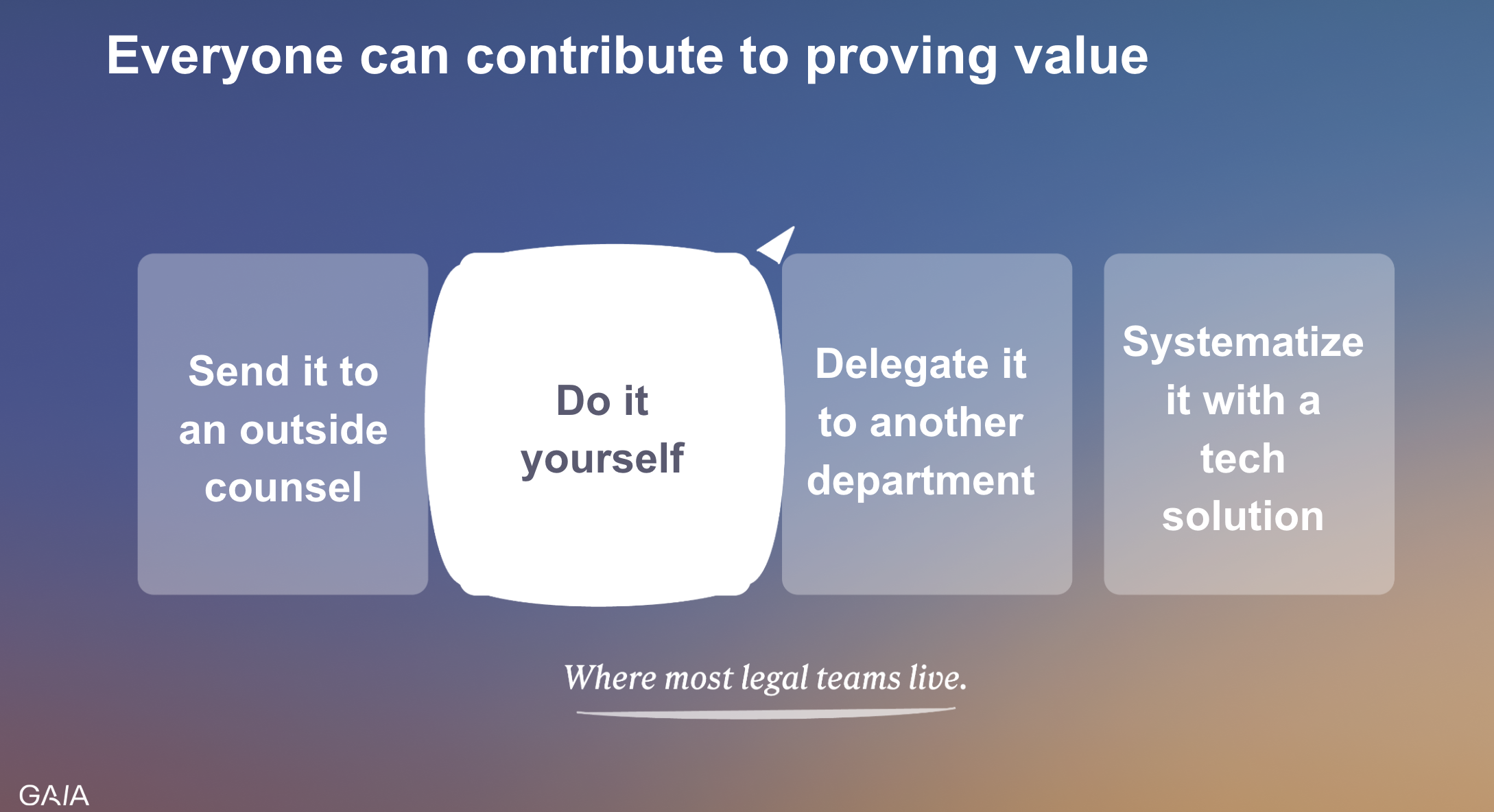
For every task that lands on your plate, you have exactly four options.
Do it yourself. Send it to outside counsel. Delegate it to another department. Or systematise it with a tech solution.
Most legal teams default to the first one almost every time. That's where the problem starts.
The hard truth: you cannot do everything yourself. And if you're trying to, you're not being thorough, you're being a bottleneck.
Think about how much of your week is spent on routine, repeatable work. Standard NDAs. Basic policy questions. First-pass contract reviews. Now ask yourself honestly: does that actually need a lawyer? Or does it need a good template and a trained colleague?
The goal isn't to remove legal oversight. It's to remove legal as the manual bottleneck in every step of the process. Oversight and execution are not the same thing.
Train your business partners – HR, sales, compliance – to handle routine matters themselves. Give them the tools, the templates, the guardrails. Empower them without abandoning control. And reserve your time for what genuinely requires your expertise: high-impact decisions, complex negotiations, significant risk, board-level matters.
The legal teams that have the most impact aren't the ones that touch everything. They're the ones that have built a system where the right people handle the right tasks, and legal shows up where it genuinely matters.
There's a line from Neil Strauss' Book “The Truth: An Uncomfortable Book About Relationships”
"Unspoken expectations are premeditated resentments."
Trace the last time you were frustrated with a colleague, or they were frustrated with you. Nine times out of ten, it starts with something that was never said out loud.
This is one of the most universal problems in legal departments. Not because lawyers are bad communicators, but because we're trained to be precise in writing and often vague about everything else.
When legal doesn't communicate timelines, priorities, or capacity, the business fills that silence with frustration. "It's stuck in legal" isn't always about speed. Sometimes it's about not knowing where things stand.
The fix is simpler than most people think. A quick message saying "I have this, you're in the queue, expect it by Thursday" costs you thirty seconds and buys an enormous amount of goodwill. Set realistic timelines and stick to them. If something changes, say so before the deadline – not after.
Establish service-level agreements with your internal clients, even informal ones. HR knows contracts take three days. Sales knows NDAs turn around same day. Compliance knows policy reviews take a week. When expectations are set, frustration drops almost immediately.
Silence is never neutral. It always reads as a problem.
Everything above applies to the whole legal team. This part is different. This is about the job nobody actually trains you for: being a leader, not just a lawyer.
The line I want every GC reading this to leave with:
Adding legal after a decision is already made is just legal doing damage control. It is not legal doing its job.
If the first time you hear about a deal is when somebody asks you to paper it, you're already too late. If the first time you hear about a restructuring is when HR sends the announcement, you're too late. The goal is to be in the room when strategy is being shaped and not when it's already being executed.
That's not a nice-to-have. That's the difference between a GC who matters and a GC who processes paperwork.
Three tactics actually work for getting and keeping that seat:
Ask for it, proactively. The simplest tactic and the one most GCs never do. Ask the CEO directly for a standing seat at the executive team meeting. Frame it as adding value – "I can spot issues earlier and save us time downstream". Most CEOs say yes. The ones who say no have just told you something important about how they see the role, and you should listen to that.
Speak in business outcomes, not legal risk. "This exposes us to liability" loses the room every time. "This will cost us the deal, and here's how we keep it" wins it. Same legal point. Completely different reception. Translate every legal observation into the language of revenue, customers, and timelines. That's the price of admission.
Support the CEO's relationship with the board. The board trusts the GC who makes the CEO look prepared, not the one who goes around them to score points. Be the person who makes governance smooth: clean materials, clear minutes, no surprises. Do that consistently and the seat becomes permanent.
One warning, especially for newer GCs: the fastest way to lose your seat is to talk too much. When you finally get into the executive meeting, the temptation is to demonstrate your value by speaking up on everything. Don't. Pick the one thing in that meeting that has to be said by a lawyer. Say it cleanly. Then stop. Say less, but say it with precision. That's what earns you the next meeting.
And if you're stepping into a GC role for the first time: in your first sixty days, have lunch with every single C-level executive. Especially the CEO and the CFO. Don't bring an agenda. Don't bring a deck. Bring questions. Find out what keeps each of them up at night, and what they wish legal did differently.
The seat at the table is built one relationship at a time. You build those relationships before you ever need them. By the time something goes wrong, the trust either exists or it doesn't.
If you've read this far and you're wondering what to actually do tomorrow morning, here's the honest answer.
Don't try to fix all five principles at once. Pick one. The one that, if you got it right, would change the most about how your team is perceived.
For most teams that's measurement. Because every other principle gets easier to advocate for once you have data to back it up. You can't argue for delegation without showing where your time goes. You can't argue for systematisation without showing how often the same task repeats. You can't ask for a seat at the table without bringing numbers to it.
Open the spreadsheet. Three columns. Thirty days. That's the start.
The rest follows.
Ready to rethink how your legal team operates? Let's talk.

Written by
Simona Sopova
on
May 12, 2026
Start today with GAIA - your new standard for legal management and get legal tasks done efficiently!
